
Rivet Hole Tensile Stress Failure: An Article Plan
This plan details a comprehensive exploration of rivet joint failure, focusing on tensile stress, utilizing PDF resources and research papers for detailed analysis.
Rivet joints are fundamental fasteners in aerospace and mechanical engineering, offering strong, reliable connections. However, they are susceptible to various failure modes, including shear, bearing, and critically, tensile failure. Understanding these modes, particularly tensile stress failure around rivet holes, is crucial for structural integrity. This article will delve into the mechanisms driving tensile failure, referencing available PDF resources and research papers.
We will explore how stress concentrations develop at rivet holes, initiating cracks and ultimately leading to joint failure.
Stress Concentration Around Rivet Holes
Rivet holes inherently create stress concentrations within a structural plate, significantly exceeding the nominal applied stress. This phenomenon arises from the geometric discontinuity – the hole interrupts load paths, forcing stress to redistribute around its perimeter. Analyzing these concentrations, often through Finite Element Analysis (FEA) detailed in PDF reports, is vital.
The magnitude of stress concentration is influenced by hole diameter, plate thickness, and material properties. Understanding these factors, documented in research papers, allows for optimized joint design to mitigate failure risks.
Factors Influencing Tensile Stress Failure
Tensile stress failure in riveted joints is a complex interplay of several key factors, extensively detailed in available PDF resources and research. Material properties of both the rivet and the plate are paramount; higher tensile strength materials offer greater resistance. Hole geometry, including diameter and countersinking, significantly impacts stress distribution.
Rivet interference fit also plays a crucial role, influencing preload and frictional forces. These factors, when analyzed using FEA models found in technical PDFs, determine the joint’s overall strength and susceptibility to failure under tensile loading.
3.1 Material Properties of Rivet and Plate
The tensile strength, yield strength, and ductility of both rivet and plate materials are critical determinants of failure resistance, as detailed in numerous PDF analyses. Higher strength alloys, like certain aluminum or steel grades, demonstrably improve joint performance. Material homogeneity is also vital; inconsistencies can initiate cracks.
PDF resources highlight the importance of considering Poisson’s ratio and modulus of elasticity, influencing stress distribution around the rivet hole. Careful material selection, guided by these properties, is essential for preventing premature tensile failure.
3.2 Hole Geometry (Diameter, Countersinking)
Hole diameter significantly impacts stress concentration; larger holes exacerbate tensile stress, increasing failure risk, as shown in PDF studies. Precise drilling is crucial to avoid burrs or irregularities that act as stress risers. Countersinking, when employed, must be carefully controlled – improper angles or depths introduce additional stress concentrations.
PDF analyses demonstrate that the hole preparation method influences failure initiation. Maintaining tight tolerances and smooth hole surfaces minimizes stress amplification, enhancing joint durability and preventing premature tensile failure.
3.3 Rivet Interference Fit
A proper interference fit between the rivet and hole is paramount for load distribution and preventing premature failure, detailed in numerous PDF reports. Insufficient interference leads to localized stress concentrations, accelerating crack initiation under tensile loading. Conversely, excessive interference can induce residual stresses, potentially compromising joint integrity.
PDF analyses highlight the importance of controlled installation techniques to achieve optimal interference. Factors like rivet material expansion and hole temperature must be considered to ensure a secure, stress-optimized fit, minimizing tensile stress failure risks.
Types of Rivet Failure
Rivet joints can experience several failure modes, each detailed in available PDF documentation on structural integrity. Shear failure occurs due to excessive shear stress, while bearing failure results from localized crushing of the hole material. However, tensile failure, the focus of this article, arises from direct tensile loading, often exacerbated by stress concentrations around the rivet hole.
PDF resources emphasize that understanding these distinct failure types is crucial for accurate analysis and preventative maintenance, particularly in critical applications where catastrophic failure must be avoided.
4.1 Shear Failure
Shear failure in riveted joints, extensively documented in engineering PDFs, occurs when the shear stress exceeds the rivet’s shear strength. This typically happens when loads are applied parallel to the rivet’s axis, causing the rivet to essentially ‘cut’ or shear apart. PDF analyses highlight that shear strength is dependent on rivet material and diameter.
While distinct from tensile failure, shear stresses can contribute to overall joint weakness, potentially initiating cracks that propagate under tensile loading, as detailed in structural failure PDFs.
4.2 Bearing Failure
Bearing failure, thoroughly analyzed in numerous engineering PDFs, arises from the compressive stress between the rivet and the hole wall. This occurs when the rivet ‘bears’ into the plate material, causing localized deformation and eventual failure of the plate around the hole. PDF resources emphasize that bearing strength depends on plate material, hole diameter, and rivet tightness.
Unlike shear or tensile failure, bearing failure is a localized phenomenon, but can initiate cracks that propagate under combined loading, as detailed in structural analysis PDFs.
4.3 Tensile Failure (Focus of this Article)
Tensile failure, the primary focus of this article and extensively documented in relevant PDFs, occurs when the rivet or plate material yields and fractures under tensile loading. This is often initiated at the rivet hole’s edge, where stress concentration is highest, as detailed in fracture mechanics PDFs. PDF analyses highlight the importance of rivet material strength and plate ductility.
Understanding tensile failure modes is crucial for designing robust riveted joints, preventing catastrophic structural collapse, and is a key topic in aerospace engineering PDFs.
Mechanisms of Tensile Stress Failure
Tensile stress failure mechanisms, thoroughly investigated in numerous PDFs, begin with crack initiation at the rivet hole’s edge due to stress concentration. PDFs detail how this initial crack propagates through the material, influenced by factors like load magnitude and material properties. The failure mode can be either ductile or brittle, depending on the rivet and plate materials, as explained in material science PDFs.
PDF research emphasizes the role of microscopic defects in accelerating crack growth, ultimately leading to structural failure.

5.1 Crack Initiation at Hole Edge
PDF analyses consistently demonstrate that crack initiation in rivet joints predominantly occurs at the hole edge, driven by peak tensile stresses. These stresses, significantly higher than the nominal applied stress, are a direct result of stress concentration. PDF research highlights the influence of hole surface finish; scratches or imperfections act as stress risers, accelerating crack nucleation.
Material properties, detailed in material science PDFs, dictate the initiation point, with brittle materials exhibiting earlier crack formation compared to ductile ones.
5.2 Crack Propagation
PDF studies on rivet hole failure reveal crack propagation follows a predictable path, typically along a direction perpendicular to the applied tensile stress. The rate of propagation, extensively documented in fracture mechanics PDFs, is heavily influenced by stress intensity factor and material toughness.
PDF analyses demonstrate that crack growth is initially slow, accelerating as the crack length increases and the remaining ligament area diminishes. Factors like residual stress, detailed in engineering PDFs, significantly impact propagation rates.
5.3 Ductile vs. Brittle Failure
PDF reports analyzing rivet failure categorize it as either ductile or brittle, dependent on material properties and stress state. Ductile failure, detailed in material science PDFs, exhibits significant plastic deformation before fracture, indicated by large fracture surface features.
Conversely, brittle failure, as illustrated in engineering PDFs, shows minimal deformation, resulting in a clean fracture surface. PDF analyses highlight that lower temperatures and higher strain rates promote brittle behavior, while ductility increases with temperature and slower loading.
Stress Analysis Methods
PDF resources detail various methods for analyzing stress around rivet holes. Finite Element Analysis (FEA), extensively documented in engineering PDFs, provides detailed stress distributions, accounting for complex geometries and loading conditions. Analytical methods, like Goodman and Soderberg criteria—found in design handbooks and PDFs—offer simplified, yet effective, stress calculations.

These PDFs emphasize that accurate stress analysis is crucial for predicting failure. PDFs also showcase the use of specialized software for rivet joint analysis, enabling engineers to assess stress concentrations and optimize designs for improved reliability.
6.1 Finite Element Analysis (FEA) for Rivet Joints
PDF guides demonstrate FEA’s power in modeling rivet joints, accurately predicting stress concentrations around holes—a key factor in tensile failure. These PDFs highlight the importance of mesh refinement near the hole to capture peak stresses. FEA allows for simulating various loading scenarios and material properties, crucial for assessing joint performance.
PDF tutorials showcase how to apply boundary conditions and interpret results, identifying potential failure locations; Advanced FEA techniques, detailed in research PDFs, include crack propagation modeling and residual stress analysis, enhancing predictive accuracy.
6.2 Analytical Methods (e.g., Goodman, Soderberg)
PDF resources detail classical analytical methods like Goodman, Soderberg, and Gerber criteria for predicting rivet joint failure under combined loading. These PDFs explain how to calculate allowable stress based on yield and ultimate tensile strength, factoring in stress concentration. They demonstrate applying these criteria to estimate safety factors.
PDF examples illustrate calculating stress concentrations around rivet holes using theoretical formulas. While simpler than FEA, these methods, outlined in engineering handbooks (often available as PDFs), provide quick initial assessments of joint integrity and potential failure modes.
Influence of Residual Stress
PDF analyses reveal that rivet installation introduces residual stresses – tensile in the plate near the hole, compressive around the rivet. These stresses, detailed in research PDFs, significantly impact fatigue life and tensile failure resistance. Compressive residual stresses can improve fatigue performance by delaying crack initiation.
However, tensile residuals exacerbate the risk of failure. PDF studies demonstrate how shot peening or other surface treatments can intentionally induce compressive residual stresses, enhancing joint durability. Understanding and controlling these stresses is crucial for reliable rivet joint design, as shown in available PDF documentation.
Fatigue Failure in Riveted Joints
PDF resources highlight that riveted joints are susceptible to fatigue failure under cyclic loading, often initiated at the rivet hole. Stress amplitude and mean stress, as detailed in numerous PDFs, are critical parameters. Higher stress amplitudes accelerate crack growth, while tensile mean stresses reduce fatigue life.
S-N curves, readily available in PDF format for various rivet materials, illustrate the relationship between stress and cycles to failure. PDF analyses demonstrate the importance of considering joint geometry and material properties when predicting fatigue life. Proper design and inspection are vital to prevent catastrophic failure.
8.1 Stress Amplitude and Mean Stress Effects
PDF analyses reveal that stress amplitude significantly impacts fatigue life in riveted joints; higher amplitudes drastically reduce it. Mean stress, particularly tensile, exacerbates fatigue damage, lowering the number of cycles to failure. PDF resources detail how these effects are often modeled using Goodman, Soderberg, or Gerber criteria.
Understanding these interactions is crucial for accurate life prediction. PDF studies demonstrate that a higher mean stress reduces the allowable stress amplitude. Careful consideration of both parameters, informed by PDF data, is essential for robust rivet joint design and preventing premature failure.
8.2 S-N Curves for Rivet Materials
PDF documentation consistently highlights the importance of S-N (Stress-Number of Cycles) curves for rivet materials. These curves, often found within PDF research papers, graphically represent fatigue life under cyclic loading. Different rivet alloys – aluminum, steel – exhibit distinct S-N characteristics.
PDF analyses show that steeper curves indicate lower fatigue resistance. Accurate S-N data, sourced from PDF reports, is vital for predicting joint durability. Factors like surface finish and residual stress influence curve shape, as detailed in numerous PDF studies, impacting failure prediction.
Corrosion and its Impact on Failure
PDF reports frequently demonstrate corrosion’s significant role in rivet joint failure, particularly concerning tensile stress. Galvanic corrosion, detailed in several PDF analyses, occurs when dissimilar metals are joined, accelerating degradation. Environmental factors, like salt spray (documented in PDF testing results), exacerbate corrosion rates.
PDF studies reveal corrosion pits initiate cracks at rivet holes, reducing tensile strength. Protective coatings, discussed in PDF material selection guides, mitigate corrosion. Regular inspection, guided by PDF NDI techniques, is crucial for detecting corrosion before catastrophic failure occurs, as shown in case study PDFs.
Material Selection for Rivets and Plates
PDF resources emphasize careful material selection to prevent tensile stress failure. Aluminum alloys (detailed in PDF datasheets) offer high strength-to-weight ratios, crucial for aerospace applications, but are susceptible to corrosion – addressed in related PDF reports. Steel alloys, outlined in PDF engineering guides, provide superior strength and fatigue resistance.

PDF analyses highlight the importance of matching rivet and plate materials to minimize galvanic corrosion. PDF material specifications detail required tensile strengths and ductility. Selecting appropriate alloys, as per PDF standards, significantly impacts joint longevity and resistance to failure under tensile loads, as demonstrated in PDF case studies.
10.1 Aluminum Alloys
PDF documentation details various aluminum alloys (2024, 7075) commonly used in riveted joints, noting their high strength-to-weight ratio. However, PDF reports caution about susceptibility to corrosion, particularly in marine environments, impacting tensile strength. PDF datasheets specify yield and tensile strengths crucial for resisting hole-induced stress.
PDF analyses emphasize heat treatment effects on alloy properties. Selecting the correct alloy, as detailed in PDF material guides, is vital. PDF research highlights the importance of surface treatments to mitigate corrosion and enhance fatigue life, preventing premature tensile failure around rivet holes, as shown in PDF case studies.

10.2 Steel Alloys

PDF resources showcase steel alloys (e.g., 4340, alloy steel) offering superior tensile strength and fatigue resistance compared to aluminum, crucial for high-stress applications. PDF datasheets detail varying hardenability and tempering characteristics impacting rivet performance. PDF reports highlight steel’s lower corrosion susceptibility, though still requiring protective coatings.
PDF analyses emphasize the importance of proper heat treatment to achieve optimal strength. Selecting appropriate steel grades, per PDF material specifications, is paramount. PDF research demonstrates steel’s resilience against crack propagation, delaying tensile failure around rivet holes, as illustrated in PDF failure analysis reports;
Non-Destructive Inspection (NDI) Techniques
PDF guides detail Ultrasonic Testing (UT) for detecting internal flaws within rivets and around holes, crucial for assessing tensile stress failure risk. PDF reports showcase Radiographic Testing (RT), using X-rays, to visualize crack initiation and propagation. PDF standards outline Eddy Current Testing (ECT) for surface flaw detection.
PDF analyses emphasize Dye Penetrant Inspection (DPI) for identifying surface cracks, precursors to tensile failure. PDF resources highlight phased array UT for improved flaw characterization. Proper NDI, as detailed in PDF manuals, ensures early detection, preventing catastrophic failure, and extending service life, per PDF maintenance schedules.
11.1 Ultrasonic Testing
PDF resources detail Ultrasonic Testing (UT) as a primary NDI method for rivet hole tensile stress failure assessment. PDF guides explain utilizing high-frequency sound waves to detect internal flaws, like cracks, not visible externally. PDF reports showcase A-scan and B-scan imaging for flaw size and location.
PDF standards outline proper probe selection and calibration for accurate readings; PDF analyses emphasize couplant use for optimal sound transmission. UT, as described in PDF manuals, identifies stress corrosion cracking and fatigue damage around rivet holes, crucial for preventative maintenance, per PDF inspection protocols.
11.2 Radiographic Testing
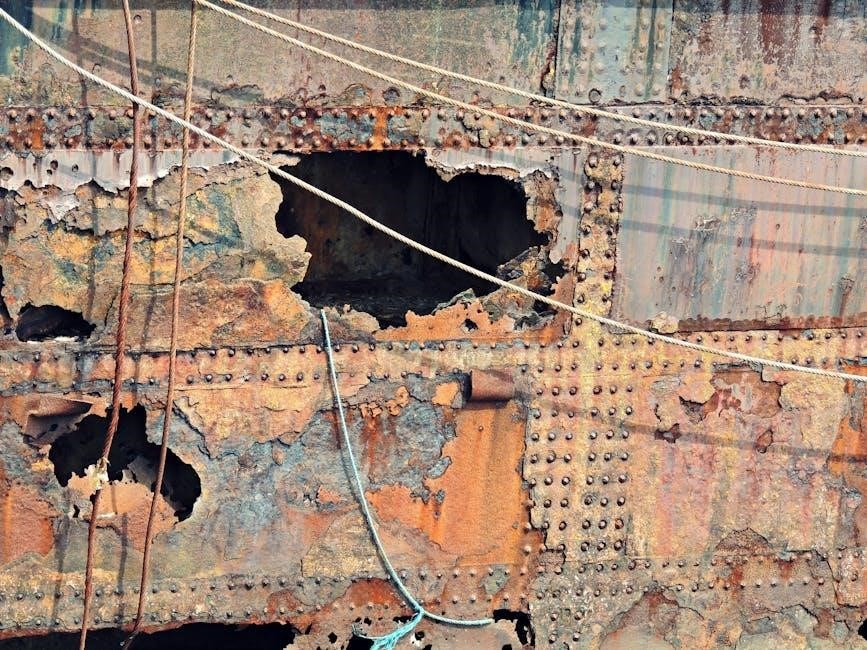
PDF documentation highlights Radiographic Testing (RT) as a valuable Non-Destructive Inspection (NDI) technique for rivet hole tensile stress failure detection. PDF guides detail using X-rays or gamma rays to visualize internal defects within rivet joints. PDF reports demonstrate identifying cracks, voids, and corrosion not readily apparent.
PDF standards specify film selection, exposure settings, and safety protocols. PDF analyses emphasize interpreting radiographic images for flaw characterization. RT, as outlined in PDF manuals, assesses rivet integrity and hole wall thickness, crucial for structural health monitoring, according to PDF inspection guidelines.
Repair Strategies for Damaged Rivet Joints
PDF resources detail several repair strategies for rivet joints exhibiting tensile stress failure. PDF guides outline options like cold expansion, which increases rivet hole bearing strength, as shown in PDF case studies. PDF documentation emphasizes proper surface preparation before repair, preventing further corrosion.
PDF reports suggest utilizing alternative fasteners, like Hi-Lok or blind rivets, detailed in PDF specifications. PDF analyses highlight the importance of following approved repair schemes, ensuring structural integrity. PDF manuals stress thorough inspection post-repair, verifying effectiveness and adherence to safety standards.
Case Studies of Rivet Hole Tensile Failure
PDF reports document numerous case studies of rivet hole tensile failure, often linked to aircraft structures. These PDF analyses reveal failures stemming from corrosion, improper installation, and material fatigue, detailed within PDF investigation reports. PDF documentation showcases examples in aluminum alloys, highlighting crack initiation points.
PDF findings emphasize the critical role of stress concentration around rivet holes. PDF studies illustrate how flawed hole preparation accelerates failure. PDF reports demonstrate the effectiveness of Non-Destructive Inspection (NDI) in early detection, preventing catastrophic events, as outlined in PDF regulatory documents.
Standards and Regulations
PDF documents from the FAA outline stringent regulations for aircraft rivet joints, addressing tensile stress failure prevention. These PDF guidelines detail inspection protocols and acceptable failure limits. PDF versions of ASTM standards specify material properties and testing procedures for rivets and plates, crucial for mitigating failure risks.
PDF regulatory compliance ensures structural integrity. PDF reports detail acceptable stress levels and fatigue life expectations. PDF documentation covers repair procedures and material certifications. Adherence to these PDF-based standards is paramount for safety, as detailed in publicly available PDF reports;
14.1 FAA Regulations (Aircraft Applications)

PDF documents detailing FAA regulations mandate rigorous inspection of rivet joints in aircraft, specifically addressing tensile stress failure. These PDFs outline acceptable damage limits and repair procedures, crucial for maintaining airworthiness. PDF compliance reports are required for all structural modifications involving rivets.
PDF guidance specifies non-destructive inspection (NDI) techniques, like ultrasonic testing, to detect cracks. PDF regulations dictate material certifications and installation protocols. PDF records must demonstrate adherence to approved engineering designs. Failure to comply with these PDF-based rules can result in severe penalties.
14.2 ASTM Standards
PDF versions of ASTM standards provide detailed specifications for rivet materials, installation procedures, and testing methods related to tensile stress failure. These PDF documents define acceptable rivet hole tolerances and surface preparation requirements. PDF reports documenting material properties are essential for compliance.
PDF guidelines cover NDI techniques, ensuring accurate crack detection. PDF standards outline procedures for evaluating rivet joint strength and fatigue resistance. PDF documentation of testing results is crucial for certification. Adherence to ASTM PDFs ensures structural integrity and safety.
PDF Resources and Research Papers
PDF documents detailing fracture mechanics are vital for understanding crack initiation and propagation around rivet holes. Numerous research PDFs explore finite element analysis (FEA) models predicting tensile stress distribution. Accessing PDF reports on material fatigue behavior is crucial for assessing long-term reliability.
PDF databases contain case studies of rivet failure, offering practical insights. PDF guides on non-destructive inspection (NDI) techniques aid in early damage detection. PDF versions of industry standards, like those from ASTM, provide essential specifications. These PDF resources are foundational for analysis.
The Role of Hole Preparation
Proper hole preparation significantly impacts tensile stress distribution around rivets. PDF resources emphasize the importance of accurate hole diameter and alignment to minimize stress concentrations. Deburring and countersinking, detailed in PDF guides, reduce crack initiation points. Surface finish, documented in material science PDFs, affects fatigue life.
Improper drilling introduces residual stresses, analyzed in fracture mechanics PDFs. Hole ovality, addressed in manufacturing PDFs, exacerbates stress. Careful preparation, as outlined in engineering PDFs, enhances joint durability and prevents premature tensile failure.
Effects of Rivet Installation Techniques

Rivet installation profoundly influences tensile stress and failure resistance. PDF guides detail proper clamping force application, crucial for interference fit. Incorrect setting, analyzed in aerospace engineering PDFs, introduces residual stresses and plastic deformation. Improperly formed rivet heads, documented in quality control PDFs, create stress risers.
Installation sequence, outlined in assembly PDFs, affects overall joint load distribution. Tooling calibration, detailed in maintenance PDFs, ensures consistent results. Following recommended techniques, per manufacturer PDFs, minimizes tensile failure risks.
Environmental Factors and Failure
Corrosion significantly accelerates rivet hole tensile stress failure, detailed in materials science PDFs. Exposure to salt spray, humidity, and chemicals, analyzed in aerospace maintenance PDFs, weakens rivet material and creates pitting. Galvanic corrosion, explained in corrosion engineering PDFs, occurs with dissimilar metals.
Temperature fluctuations, documented in structural analysis PDFs, induce thermal stresses. UV radiation, discussed in materials degradation PDFs, impacts polymer-based rivet materials. Protective coatings, detailed in surface treatment PDFs, mitigate environmental effects.
Advanced Materials and Rivet Designs
PDF research highlights advanced materials resisting tensile stress failure. Titanium alloys, detailed in aerospace engineering PDFs, offer high strength-to-weight ratios. Composite rivets, analyzed in materials science PDFs, reduce weight and corrosion. Friction stir welding (FSW) rivets, documented in joining technology PDFs, enhance joint integrity;
Self-piercing rivets, discussed in manufacturing PDFs, eliminate hole preparation. Blind rivets with locking mechanisms, detailed in fastening technology PDFs, simplify installation. Optimized hole geometries, analyzed in stress analysis PDFs, minimize stress concentration.
Future Trends in Rivet Joint Technology
PDF studies predict increased use of adaptive rivets responding to stress, minimizing tensile failure. Self-healing materials, detailed in materials science PDFs, will repair micro-cracks. Digital twin technology, explored in engineering PDFs, will simulate rivet performance. AI-driven design optimization, documented in computational mechanics PDFs, will enhance joint reliability.
Additive manufacturing (3D printing) of rivets, analyzed in manufacturing PDFs, allows customized designs. Integration of sensors, detailed in instrumentation PDFs, will monitor stress levels. Predictive maintenance, explored in reliability engineering PDFs, will prevent failures.
Modeling Crack Growth
PDF research focuses on Finite Element Analysis (FEA) to model crack initiation and propagation around rivet holes under tensile stress. Fracture mechanics PDFs detail Paris’ Law for predicting crack growth rates. Cohesive zone modeling, explained in materials modeling PDFs, simulates crack interface behavior.
XFEM (Extended Finite Element Method), detailed in computational mechanics PDFs, efficiently models crack growth without remeshing. Damage mechanics PDFs explore material degradation before fracture. Validating models with experimental data, found in testing PDFs, is crucial for accuracy.
Experimental Validation of Models
PDF reports detail tensile testing of riveted joints to validate FEA models predicting failure. Digital Image Correlation (DIC), explained in testing PDFs, measures strain fields around rivet holes. Fracture surface analysis, documented in materials science PDFs, confirms crack initiation sites.
Fatigue testing PDFs outline procedures for assessing crack growth rates under cyclic loading. Comparing model predictions with experimental results, detailed in validation PDFs, ensures accuracy. Strain gauges, described in instrumentation PDFs, provide localized stress measurements for model calibration.
PDF analyses reveal rivet hole tensile stress failure is a complex interplay of material properties, geometry, and loading. Accurate prediction requires robust modeling, validated by experimental data detailed in numerous PDF reports. Understanding crack initiation and propagation, as outlined in fracture mechanics PDFs, is crucial.
Further research, accessible through academic PDF databases, should focus on advanced materials and inspection techniques; Comprehensive PDF guides on NDI are essential for preventative maintenance. Ultimately, a holistic approach, informed by detailed PDF documentation, ensures structural integrity.