
Exploring biblical geography reveals a fascinating journey from ancient sketches to modern, detailed PDF maps, aiding scriptural understanding and historical context.
Historical Significance of Biblical Cartography
Throughout history, mapping the biblical world wasn’t merely about geographical representation; it was deeply intertwined with theological understanding and asserting control. Early maps, often rudimentary, served to locate sacred sites and visualize biblical narratives, solidifying faith and pilgrimage routes.
The creation of these maps, even in ancient times, reflected prevailing worldviews. Later, the advent of printing and the increased availability of PDF Bible maps democratized access to this geographical knowledge.
Today, downloadable PDF maps offer a convenient way to study biblical locations, bridging the gap between ancient cartography and modern scholarship. These resources demonstrate how our understanding of the Bible has evolved alongside our mapping capabilities.
The Evolution of Mapmaking Techniques
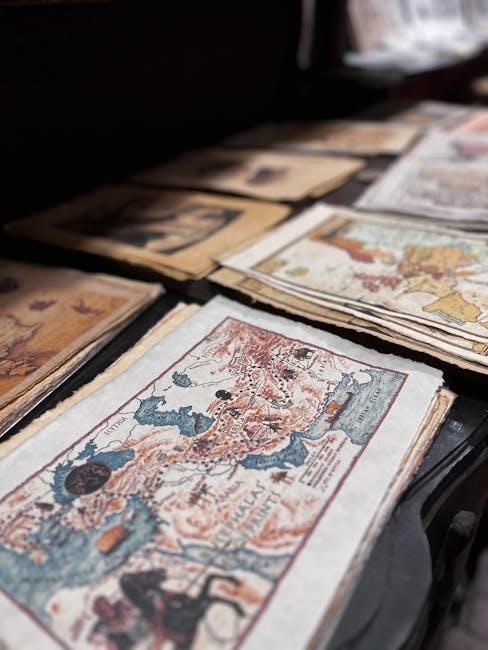
Initially, biblical mapmaking relied on textual descriptions and oral traditions, resulting in schematic representations rather than accurate depictions. The transition from hand-drawn sketches to the detailed Madaba Mosaic Map marked a significant leap, showcasing regional landscapes.
Ptolemy’s Geography introduced coordinate systems, influencing cartography for centuries, though with inherent inaccuracies. The digital revolution brought satellite imagery and GIS technology, enabling precise PDF Bible map creation.
Now, interactive digital atlases and readily available PDF resources offer unparalleled detail. This evolution reflects a shift from faith-based interpretations to scientifically grounded representations, enhancing biblical study.
Ancient Biblical Maps (Then)
Early cartography was rudimentary, relying on narratives and landmarks; the Tel Dan Stele and Madaba Map offer glimpses into ancient geographical understanding.
Early Mapmaking in the Biblical World
Before precise surveying, mapmaking in the biblical era was intrinsically linked to storytelling and practical needs – defining boundaries, illustrating possessions, and recounting journeys. These weren’t maps as we envision them today, but rather conceptual representations of space. Think of descriptions within Genesis, detailing the land of Canaan, or the itineraries of Abraham and Paul’s missionary travels.
Early attempts focused on portraying relationships between key cities and geographical features like rivers and mountains, often prioritizing theological significance over strict accuracy. The focus wasn’t on precise measurement, but on conveying the idea of a place and its importance within the biblical narrative. PDF versions of reconstructions attempt to visualize these ancient understandings, offering a bridge between textual descriptions and spatial awareness. These early maps, though limited, laid the groundwork for later, more sophisticated cartography.
The Tel Dan Stele and Ancient Boundaries
Discovered in 1993, the Tel Dan Stele provides invaluable insight into ancient boundary demarcation and political landscapes of the 9th century BCE. This fragmented stone inscription, written in Aramaic, commemorates a victory by a king of Damascus over the “House of David,” confirming a historical Davidic dynasty. Crucially, it references territorial control and likely depicts a border region.
The stele’s significance for biblical mapping lies in its corroboration of biblical accounts concerning the kingdoms of Israel and Judah. Modern maps, often available as downloadable PDF resources, incorporate this archaeological evidence to refine our understanding of ancient political boundaries. Comparing the stele’s implied territory with biblical descriptions allows for a more nuanced reconstruction of the land as it existed during the Iron Age, enhancing the accuracy of digital and printed maps.
The Madaba Mosaic Map: A 6th-Century Masterpiece
Unveiled in 1884 within the Church of Saint George in Madaba, Jordan, this Byzantine-era mosaic is a remarkably detailed depiction of the Holy Land and surrounding regions. Created around 560 CE, it’s the oldest known geographical mosaic of the area, showcasing cities, villages, and significant biblical sites. The map extends from Lebanon in the north to the Nile Delta in Egypt.
Its value for modern biblical cartography is immense. While not entirely accurate by today’s standards, it offers a unique perspective on how the land was perceived in the 6th century. High-resolution images of the mosaic are frequently included in digital Bible atlases and downloadable PDF maps, allowing scholars and enthusiasts to compare ancient representations with contemporary geographical data, bridging the gap between ‘then and now’.
Ptolemy’s Geography and its Influence
Claudius Ptolemy’s Geography, a comprehensive treatise written in the 2nd century CE, profoundly impacted mapmaking for over 1400 years. Though focused on the Roman world, its systematic approach to mapping using latitude and longitude provided a foundational framework for representing the known world, including biblical lands. Ptolemy’s work, however, contained significant inaccuracies in estimating distances and the size of the Earth.
Despite these flaws, his system heavily influenced medieval and Renaissance cartographers. Early printed Bible maps often relied on Ptolemy’s projections. Modern comparisons, readily available in PDF Bible map resources, highlight the evolution of accuracy. Examining Ptolemy’s maps alongside contemporary satellite imagery demonstrates the dramatic advancements in geographical understanding – a clear ‘then and now’ contrast.

Limitations of Ancient Maps: Accuracy and Perspective
Ancient biblical maps were inherently limited by available technology and prevailing worldviews. Accuracy suffered from reliance on travelers’ accounts, estimations, and a lack of precise surveying tools. Perspective differed drastically; maps weren’t always intended as geographically precise representations, but often served symbolic or theological purposes.
Early mapmakers lacked a global understanding, frequently depicting the world as flat and centered on Jerusalem. Comparing these ancient depictions – often found digitized in PDF Bible map collections – with modern satellite imagery reveals stark differences. These PDFs showcase the progression from conceptual representations to scientifically accurate portrayals, highlighting the evolution of cartography and our understanding of biblical landscapes.

Modern Bible Maps (Now)
Contemporary Bible maps leverage archaeology, satellite data, and GIS technology, offering detailed PDF resources for enhanced scriptural study and geographical insight.
The Rise of Archaeological Mapping
The late 19th and 20th centuries witnessed a paradigm shift in biblical cartography, driven by extensive archaeological excavations across the Levant. Early explorers and scholars, initially relying on textual descriptions, began correlating biblical sites with physical locations uncovered through systematic digs. This marked a move away from solely relying on ancient, often imprecise, maps like those influenced by Ptolemy’s Geography.
Significant discoveries at sites like Tel Dan, mentioned in the provided context, provided concrete evidence for ancient boundaries and kingdoms. Archaeological surveys, combined with increasingly sophisticated surveying techniques, allowed for the creation of more accurate topographical maps. These maps, often published in scholarly journals and eventually compiled into accessible PDF Bible atlases, revolutionized biblical studies. The ability to visualize the physical landscape described in scripture offered new perspectives on historical events and geographical contexts, enriching understanding beyond textual interpretation.
Satellite Imagery and GIS Technology
The advent of satellite imagery and Geographic Information Systems (GIS) represents a monumental leap forward in Bible mapping. Unlike earlier methods dependent on ground surveys, satellites provide a comprehensive, bird’s-eye view of the biblical landscape, revealing subtle topographical features and ancient road networks previously undetectable. GIS technology allows for the layering of archaeological data, historical maps, and biblical texts onto a single, interactive platform.
This integration facilitates detailed analysis and the creation of highly accurate digital Bible maps, often available as downloadable PDF atlases. These modern maps surpass the limitations of ancient cartography, offering unparalleled precision and detail. Researchers can now model ancient environments, reconstruct historical landscapes, and visualize biblical events with a level of accuracy unimaginable just decades ago, enhancing both scholarly research and personal study.
Digital Bible Atlases and Interactive Maps
Modern digital Bible atlases, frequently offered as downloadable PDF resources, have revolutionized biblical study. These atlases move beyond static images, providing interactive maps with zoom capabilities, layered information, and searchable place names. Users can explore biblical sites, trace journeys of key figures, and examine topographical features with unprecedented ease. Many platforms allow for cross-referencing with scripture, linking geographical locations directly to relevant biblical passages.
Interactive maps often incorporate GIS data and satellite imagery, offering a dynamic and immersive experience. PDF formats ensure accessibility across various devices, while interactive versions provide enhanced functionality. These tools empower students, pastors, and enthusiasts to deepen their understanding of the biblical world, bridging the gap between ancient text and modern geography.
Comparing Modern Maps to Biblical Descriptions
Juxtaposing modern maps – often available as detailed PDF Bible maps – with the geographical descriptions found within scripture reveals both remarkable consistency and intriguing complexities. While ancient texts lack precise coordinates, their relative placements and topographical details often align surprisingly well with contemporary surveys and satellite imagery. Discrepancies, however, highlight the evolving understanding of ancient place names and shifting landscapes over millennia.
PDF map resources facilitate this comparative analysis, allowing users to overlay biblical accounts onto modern geographical data. This process illuminates the historical context of biblical events and aids in interpreting ambiguous passages. Careful comparison fosters a deeper appreciation for the accuracy and nuance of biblical narratives, while acknowledging the limitations of ancient cartography.
The Importance of Topographical Data
Topographical data is crucial for interpreting biblical narratives, and modern PDF Bible maps excel in presenting this information. Understanding elevation, terrain, and water sources profoundly impacts how we visualize journeys, battles, and settlements described in scripture. Ancient mapmakers lacked the tools for precise topographical representation, relying on estimations and symbolic depictions.
Contemporary maps, utilizing satellite imagery and GIS technology, offer detailed contour lines and elevation models. This allows for a more accurate reconstruction of ancient landscapes, revealing strategic advantages, natural barriers, and potential routes. Accessing these details through downloadable PDF maps enhances biblical study, providing a tangible connection between text and terrain.
Key Geographical Features & Mapping Changes
PDF Bible maps showcase evolving understandings of key regions – Canaan, the Jordan Valley, Jerusalem, and Mesopotamia – reflecting archaeological discoveries and improved accuracy.
Mapping the Land of Canaan/Israel
Historically, mapping Canaan/Israel relied on textual descriptions and limited surveying, resulting in generalized representations within ancient PDF scrolls and later printed maps. These early depictions often prioritized symbolic or theological significance over precise geographical accuracy.
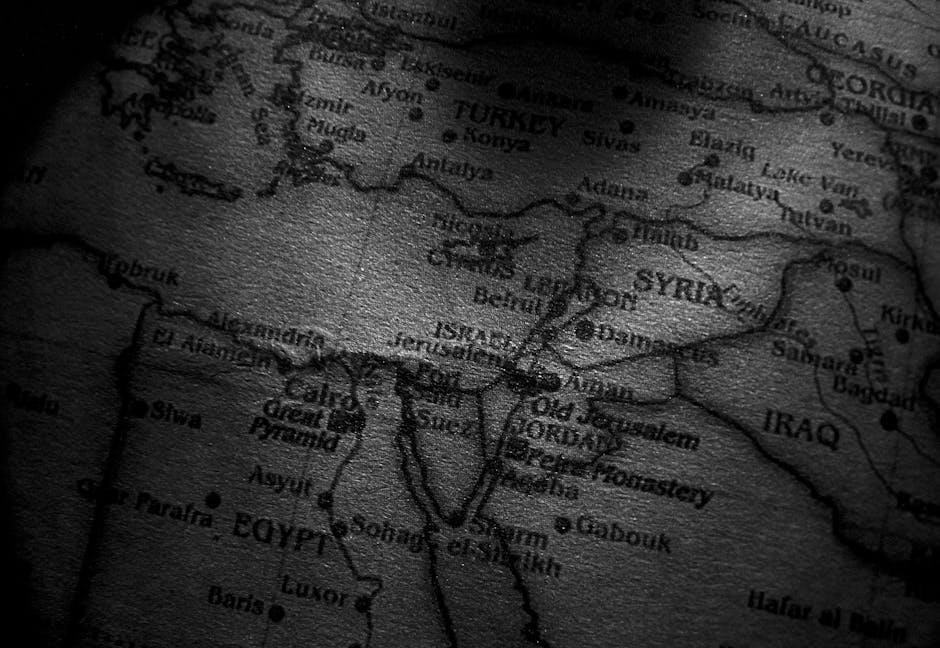
Modern PDF Bible maps, however, leverage extensive archaeological data, satellite imagery, and Geographical Information Systems (GIS) to present a far more detailed and accurate portrayal. Changes include refined coastlines, precise locations of ancient cities like Jericho and Jerusalem, and detailed topographical features.
The shifting understanding of Canaan’s boundaries, influenced by archaeological finds and textual analysis, is clearly visible when comparing older and newer PDF maps. These advancements allow for a richer comprehension of biblical narratives unfolding within a geographically grounded context.
Changes in Mapping the Jordan River Valley
Ancient maps of the Jordan River Valley, often found within early PDF manuscripts, presented a simplified view, primarily focusing on the river’s course and major cities like Jericho. Accuracy was limited by surveying techniques and a lack of detailed topographical data. The Dead Sea’s shape and size were frequently misrepresented.
Contemporary PDF maps demonstrate significant improvements, utilizing satellite imagery and GIS technology to reveal the valley’s complex geological features – including rift valleys, fault lines, and varying elevations. Detailed representations of the Dead Sea’s shoreline and salinity levels are now common.
These changes enhance our understanding of biblical events occurring within this crucial region, offering a more nuanced geographical context for narratives like the Israelites’ crossing of the Jordan.
Mapping Jerusalem: From Ancient City to Modern Metropolis
Historical PDF maps of Jerusalem, often derived from medieval sources, depicted a walled city centered around the Temple Mount, with limited detail regarding surrounding areas. These early representations prioritized religious sites over accurate urban planning, showcasing a symbolic rather than realistic portrayal.
Modern PDF maps, leveraging archaeological discoveries and aerial photography, reveal Jerusalem’s extensive growth and complex urban structure. Detailed depictions of the Old City’s quarters, the City of David, and modern neighborhoods are now readily available.
This evolution allows for a deeper understanding of Jerusalem’s historical layers and its significance as a focal point of religious and political events, enriching biblical interpretation.
Mapping the Sinai Peninsula: Challenges and Discoveries
Ancient mapping of the Sinai Peninsula, found within early PDF biblical atlases, was largely conceptual, focusing on the route of the Exodus and Mount Sinai’s location – often imprecise due to limited exploration and reliance on textual descriptions. These maps prioritized theological significance over geographical accuracy.
Contemporary PDF maps, benefiting from satellite imagery and extensive archaeological surveys, offer a far more detailed understanding of Sinai’s topography, wadis, and ancient settlements. Discoveries have refined our knowledge of potential routes and locations.
This shift enables a more informed reconstruction of biblical events and a nuanced appreciation of the harsh environment faced by the Israelites.
Mapping the Regions of Mesopotamia (Iraq)
Historically, Mesopotamian mapping within early PDF Bible maps relied heavily on classical sources like Ptolemy, combined with biblical accounts of cities like Babylon, Nineveh, and Ur. These depictions, while valuable, were often generalized and lacked precise detail, reflecting limited firsthand knowledge of the region’s complex river systems and shifting landscapes.
Modern PDF maps, leveraging satellite data and archaeological excavations, provide a dramatically improved understanding of Mesopotamia’s geography. Detailed topographical features, ancient city locations, and irrigation systems are now accurately represented.
This allows for a more precise contextualization of biblical narratives set in this cradle of civilization.
PDF Bible Maps: Accessibility and Usage
PDF Bible maps offer convenient access to geographical insights, blending historical cartography with modern data for enhanced study and understanding.
Advantages of PDF Format for Bible Maps
PDFs excel in preserving map detail and formatting across various devices, ensuring consistent visual representation regardless of the user’s operating system or software; This portability is crucial for students, researchers, and anyone studying biblical geography on the go.
Furthermore, PDFs support high-resolution images, vital for displaying intricate ancient maps or detailed satellite imagery. They also allow for easy annotation – highlighting key locations, adding personal notes, or tracing biblical journeys directly onto the map.
Unlike image-based formats, PDFs often contain selectable text, enabling quick searches for specific place names or geographical features. The compact file size of many PDFs also facilitates easy storage and sharing, making them ideal for distributing comprehensive biblical atlases. Accessibility features within PDF readers further enhance usability for all learners.
Popular Sources for Downloadable PDF Bible Maps
Numerous online resources offer free and premium downloadable PDF Bible maps. Bible History Online provides a collection of historical maps illustrating biblical events and locations. Blue Letter Bible offers interactive maps alongside scripture, with PDF export options for certain views.
For detailed archaeological maps, consider exploring resources from institutions like the Israel Museum or the British Museum, often providing downloadable PDFs of exhibits. Websites specializing in biblical studies, such as Associates for Biblical Research, frequently feature downloadable map sets.
Additionally, many publishers offer sample maps or complete atlases in PDF format as promotional material. Searching for “Bible map PDF” yields a wealth of options, but verifying source credibility is crucial for accuracy.
Navigating and Utilizing PDF Map Features
Modern PDF Bible maps often include interactive features enhancing usability. Utilize the search function to locate specific cities or regions mentioned in scripture. Zoom functionality allows for detailed examination of topographical features and ancient boundaries.
Layered maps are particularly valuable, enabling users to toggle between political, topographical, and archaeological data. Many PDFs contain clickable links to relevant biblical passages, streamlining research. Annotation tools facilitate note-taking and personal study, highlighting key locations or routes.
Familiarize yourself with the map’s legend to understand symbols and color coding. Regularly updated PDFs may offer improved clarity and accuracy compared to older versions.
Printing and Annotation of PDF Bible Maps
PDF Bible maps offer convenient printing options for offline study, though color accuracy may vary depending on your printer. Consider grayscale printing to conserve ink. Annotation features, available in most PDF readers, allow direct marking on the map – highlighting trade routes, battle locations, or prophetic journeys.
Digital pens and tablets enhance annotation capabilities, enabling freehand drawing and detailed notes. Save annotated versions separately to preserve the original PDF; When printing, adjust scaling to fit the map appropriately on the page.
Remember to check printing settings for optimal resolution and paper size for clear visibility.

Theological Implications of Accurate Mapping
Precise biblical maps deepen scriptural comprehension, revealing geographical context crucial for interpreting narratives and understanding God’s promises to His people.
Understanding Biblical Narratives Through Geography
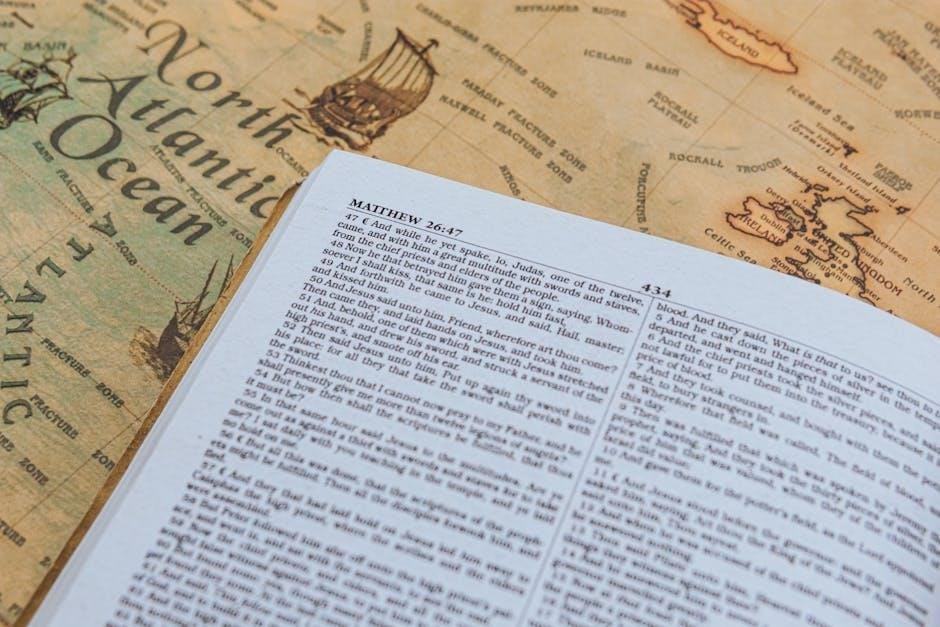
Historically, comprehending biblical stories relied on limited geographical knowledge, often shaped by ancient perspectives and rudimentary mapmaking. Now, detailed PDF Bible maps offer a transformative lens. They illuminate the physical settings of pivotal events, enriching our understanding of journeys like Abraham’s travels or Paul’s missionary voyages.
Accurate mapping reveals how terrain influenced battles, how cities’ locations impacted trade, and how landscapes symbolized spiritual truths. For example, visualizing the mountainous terrain of Canaan provides context for Israel’s struggles for the Promised Land. Modern maps, accessible in PDF format, allow users to trace these narratives, fostering a deeper connection to the biblical text. They bridge the gap between ancient accounts and contemporary understanding, enhancing theological insight.
PDF maps facilitate interactive exploration, enabling readers to visualize the spatial relationships between places and events, ultimately enriching their interpretation of scripture.
Mapping the Journeys of Biblical Figures
Tracing the paths of figures like Abraham, Moses, and Paul becomes profoundly impactful with detailed maps. Anciently, understanding these journeys relied on fragmented descriptions and limited geographical knowledge. Today, PDF Bible maps provide a visual reconstruction of these pivotal travels, revealing distances, terrains, and strategic locations.
Modern cartography, readily available in PDF format, allows us to follow the Exodus route, visualize Paul’s missionary expeditions across the Roman Empire, or retrace David’s flight from Saul. These maps aren’t merely geographical representations; they’re narrative tools, illuminating the challenges and triumphs faced by biblical characters.
PDF accessibility enables interactive exploration, allowing users to zoom, annotate, and compare routes, fostering a deeper appreciation for the scope and significance of these journeys.
The Significance of Place Names in Scripture
Biblical place names aren’t simply labels; they often carry historical, cultural, and theological weight. Understanding their etymology and geographical context unlocks deeper layers of meaning within scripture. Anciently, this required extensive linguistic and archaeological research, often yielding incomplete results.
Modern PDF Bible maps integrate this knowledge, providing detailed annotations that explain the significance of locations like Jericho, Bethlehem, or Gethsemane. These maps reveal how place names reflect events, characteristics, or even prophetic foreshadowing.
Digital resources allow for cross-referencing with biblical texts, enhancing comprehension. PDF format ensures easy access to this vital information, enriching our understanding of scripture’s geographical and symbolic landscape.
Connecting Biblical Events to Modern Locations
Modern Bible maps, particularly those in accessible PDF format, bridge the gap between ancient narratives and present-day geography. They allow us to visualize the journeys of biblical figures – Abraham’s travels, the Exodus route, or Paul’s missionary voyages – overlaid onto contemporary landscapes.
PDF maps often incorporate archaeological data, pinpointing the likely locations of ancient cities and landmarks. This connection fosters a tangible understanding of biblical events, moving them beyond abstract stories to historically grounded realities.
Interactive features within digital maps enable users to explore these locations in detail, enhancing the immersive experience and deepening their connection to the biblical world.

Future Trends in Bible Mapping
Emerging technologies like VR and AI promise immersive, dynamic Bible maps, potentially integrated into accessible PDF formats for enhanced study.
Virtual Reality and 3D Bible Maps
The evolution of Bible maps is poised for a revolutionary leap with Virtual Reality (VR) and 3D modeling. Imagine stepping into ancient Jerusalem, walking the Via Dolorosa, or witnessing Paul’s journeys firsthand – all through immersive technology. These experiences transcend static images found in traditional or even PDF Bible maps.
Currently, detailed PDF maps offer significant advantages in accessibility and portability, but lack the experiential depth of VR. Future VR applications will likely integrate with digital Bible atlases, allowing users to explore locations mentioned in scripture in a truly engaging way. 3D reconstructions, layered onto geographical data, will provide a nuanced understanding of biblical landscapes and urban environments. This shift promises to deepen theological insights and connect believers to the biblical narrative on a profoundly personal level, moving beyond simply seeing a map to experiencing the land.
AI-Powered Map Analysis and Interpretation
Artificial Intelligence (AI) is set to transform how we interact with Bible maps, including those available in PDF format. AI algorithms can analyze ancient texts, archaeological data, and topographical information to reconstruct historical landscapes with unprecedented accuracy. This goes beyond simply displaying geographical features; AI can interpret potential routes, identify lost settlements, and even suggest plausible locations for biblical events.
Imagine an AI assistant that cross-references biblical descriptions with map data, highlighting areas of congruence and identifying potential discrepancies. Such tools could enhance the study of PDF Bible maps, offering contextual insights and prompting deeper theological reflection. Furthermore, AI could automate the process of updating maps as new archaeological discoveries emerge, ensuring that digital and PDF resources remain current and reliable, bridging the gap between ‘then and now’.
Crowdsourced Mapping and Community Contributions
The future of Bible mapping increasingly relies on collaborative efforts. Crowdsourced mapping initiatives, leveraging the collective knowledge of scholars, archaeologists, and enthusiasts, promise to enrich both digital and PDF Bible map resources. This approach allows for the continuous refinement of map data, incorporating local expertise and newly discovered information.
Community contributions can range from identifying inaccuracies in existing maps to annotating PDF versions with additional insights. Platforms enabling users to submit corrections, suggest improvements, or share relevant research foster a dynamic and evolving understanding of biblical geography. This democratization of mapmaking ensures that resources remain accessible, accurate, and reflective of the latest scholarship, bridging the ‘then and now’ through shared knowledge.